A Definition of Rural is Needed that Fits Western States’ Realities

Author: Glenda Humiston

Download the PDF

Definitions of “rural” are not standardized – some programs use definitions such as “communities under 50,000 that are rural in nature,” “areas of less than 2,500 not in census places,” or “Nonmetro County.” In addition to the confusing nature of the definitions, they generally do not relate well with realities of western states and mountainous topography – greatly impacting the eligibility of communities and individuals to access programs. The negative impact of these definitions is especially true for rural communities that have been experiencing inordinately high in-migration from other areas; growth not necessarily due to increased economic opportunity within the region, but rather from lack of affordable housing for low- and middle-income people in nearby areas.

Much of this is due to the historical practice of relying on counties as the jurisdiction for USDA’s field-based agencies.  While this has generally worked well in the east and Midwest, it does not make any sense for the western U.S. for the simple reason that our counties are extremely large. For example, San Bernardino County is larger than nine U.S. statesand is one of the THIRTY California counties that are larger than the state of Rhode Island.

This is not only a problem with current USDA definitions but can be found throughout the federal government in any program utilizing the definition of “Metropolitan” counties administered by the White House Office of Management and Budget.  As you can see from the map below, the vast majority of California is considered to be metropolitan – including the entire San Joaquin Valley and Shasta County! However, according to USDA calculations urbanized areas and urban clusters comprise only 5.1% of California’s total land mass2.

During a series of Town Hall Forums held throughout California in 2010, local elected officials, service providers and other stakeholders repeatedly raised this issue.  When asked for solutions, key recommendations included

  • Utilize census block group data instead of county level data to determine areas of persistent poverty and calculations for all programs.

Several USDA programs maintain set asides for persistent poverty counties3.  As can be seen in the map below, California has many areas suffering from persistent poverty – yet not one single county in California is considered to have persistent poverty by USDA!   This contrasts sharply with states that have much smaller counties and are able to qualify those areas (easily seen in the previous map).  Calculating persistent poverty – as well as eligibility for other programs and allocations – by census tract would improve targeting of finite resources to areas of most need.

Map provided by California State University, Chico, Center for Economic Development
  • Enable Rural Development programs to support essential community facilities in areas considered non-rural but that serve rural populations.

Hospitals, health clinics, food banks, and social facilities are often located in non-rural areas.  The rural definition should be “flexible” to support at least the portion of essential facilities that serves rural people and communities.

  • Ensure viability of agricultural support industries regardless of location.  

Although agricultural production occurs in rural areas, California’s agriculture is highly diverse and many types of processing and marketing facilities are required in non-rural areas to prepare and deliver products to various domestic and international markets. Program rules need to allow maximum flexibility in ability to support enterprises and facilities that support agriculture in non-rural areas.

  • Permanently change the grant calculation of Median Household Income (MHI).

Percentage of grant eligibility for several Rural Development programs is partially dependent on the MHI of the community as a percentage of the state non-metropolitan median household income. Using this criterion in California eliminates most of the rural population from the calculation of the state’s non-metropolitan median household income and includes only the most remote areas that tend to have lower incomes.

  • Funds should be allocated to states based on the percent of the population that lives in eligible communities.

Fifty percent of the weight allocating funds under Water and Environmental Program and Communities Facilities Program is based on rural population. This population data comes from census definitions of rural (less than 2,500 population). However program eligibilities under the actual statutes are much higher. Aligning allocations with actual population that is eligible would allow for a much more equitable allocation of funds.

  • Programs targeting small and underserved farms must clearly define the target, taking into account the many categories of small and underserved farmers not addressed in current ERS definitions.

The USDA definition of Limited Resource Farmer compares a farmer or rancher’s income to the average within a county so if you are poor in a poor county you are not qualified for priority funding.

  •  Consider terrain and topography where distance is included in the definition.

The Sierra Nevada, Cascade, and Coastal Mountains are all major land forms and the California coastline is 840 miles long.  The distances between two points may seem close if a lineal (as the crow flies) measurement is used; however, actual travel between two points can be much greater distance and quite onerous.  California’s land features and road routes must be considered in any definition for rural.

These issues are all part of the ongoing debate as the 2012 Farm Bill is being negotiated.  It is important that all citizens become more aware of these challenges and the consequences of any policy enacted.

1 Maryland, Hawaii, Massachusetts, Vermont, New Hampshire, New Jersey, Connecticut, Delaware, and Rhode Island

Urban land is based on population density and was delimited using the United States Census definitions of urbanized areas and urban clusters.  http://nrs.fs.fed.us/data/urban/state/?state=CA

USDA’s Economic Research Service defines counties as being persistently poor if 20 percent or more of their populations were living in poverty over the last 30 years (measured by the 1970, 1980, 1990, and 2000 decennial censuses). While this map only shows data available electronically, it is estimated that additions of the 1980 and 2010 Census data will have little effect on areas shown.

Fruit and Vegetable Producer Responses to Higher Labor Costs

Author: Philip Martin

Download the PDF

How would US fresh fruit and vegetable producers respond to higher labor costs?  Case studies suggest that there would be labor-saving mechanization in commodities such as raisin grapes and higher prices in strawberries.  Weather is the single most important factor affecting fresh fruit and vegetable trade, but labor and transportation costs also shape trade patterns.  Affluence created a demand for fresh fruits and vegetables year-round, and new seeds and better storage enabled producers to supply commodities year round.  Rising wages can prompt labor-saving mechanization instead of rising imports.  Vegetables are far more mechanized than fruits— about 75 percent of US vegetable and melon tonnage is machine harvested, but less than half of the fruit tonnage.  There was significant interest in mechanization in the 1960s and 1970s, when the end of the Bracero program and the rise of unions led to rapid increases in farm wages.

Publicly supported labor-saving mechanization, perhaps best symbolized by the development of the mechanical tomato harvester, waned in the 1980s as federal, state and industry contributions to university-based labor-saving researchers ended, immigration increased, and real farm wages fell.  USDA Secretary Bob Bergland said, “I will not put federal money into any project that reduces the need for farm labor,” and California Rural Legal Assistance filed a lawsuit against the University of California alleging that federal research funds were used unlawfully to develop the tomato harvester and displace small farmers and farm workers. 

Federal funding for mechanical harvesting research increased with the Food, Conservation, and Energy Act of 2008, which included “efforts to improve production efficiency, productivity, and profitability over the long term (including specialty crop policy and marketing) and new innovations and technology, including improved mechanization and technologies that delay or inhibit ripening.”  

The federal minimum wage was $5.15 an hour between September 1, 1997 and July 24, 2007, when it rose to $5.85 an hour.  In 2008 minimum wage rose again to $6.55 and then to $7.25 in 2009.  The federal minimum wage fell by 30 percent in real terms before the 2007 increases.  The California minimum wage was also $5.15 an hour on September 1, 1997, and rose to $5.75 in 1998, $6.25 in 2001, $6.75 in 2002, $7.50 in 2007, and $8 an hour in 2008.

The following case studies illustrate possible adjustment scenarios to higher wages…

Harvesting raisins has traditionally been the single most labor-intensive activity in US agriculture, requiring 45,000 to 50,000 workers for six to eight weeks.  Traditionally workers cut bunches of grapes and place them on paper trays to dry into raisins; however the rising minimum wage and concerns regarding a steady supply of harvest workers encouraged many growers to mechanize.  By some estimates, up to half of California’s raisin grapes were picked with at least some mechanization in 2010.  This trend towards mechanization has reduced the peak raisin harvest work force to perhaps 25,000 and is expected to continue.  Wages, the availability of labor and the prices that growers get paid are factors that impact mechanization.  

There are labor-saving alternatives for raisin growers, but they require investments that may not pay off for several years.  Growers who plant earlier-ripening varieties can cut the canes on which grapes grow and allow grapes to begin drying into raisins while on the vine, the so-called Dried-on-the-Vine (DOV) method of harvesting.  DOV harvesting shifts the demand for labor from the September harvest to the winter pruning season, since canes must be trained to grow in a manner that makes it easy for a wine grape harvesting machine to knock them off the vine.  Machines reduce raisin harvesting costs dramatically, but require an upfront investment in early ripening grape varieties, careful pruning, and harvest machinery. 

The major factors that slow the mechanization in raisins include: (1) the structure of the industry, including a large number of older growers with small acreages; (2) stable or declining US raisin consumption and rising imports and (3) the significant investments required for replanting and machines.

Strawberries are a success story for growers, with production and prices climbing for California growers who produce almost 90 percent of US strawberries.  California growers hope to sell their berries fresh to consumers, but send them for processing into frozen berries when there are more berries than can be sold fresh.  Imports of fresh strawberries are less than 10 percent of US fresh strawberry consumption, but imports of frozen strawberries account for over 60 percent of US frozen strawberry consumption and are rising. 

Strawberry fields are picked by hand multiple times, often every three days.  An average 1,000 hours of harvest labor is required to harvest a typical acre of strawberries, representing half of the $19,000 cost of production.  The best strawberry pickers earn $10 to $12 an hour during the peak season, but most earn less.  In surveys of farm employers, strawberry workers have the lowest average hourly earnings, an average $9.13 an hour in 2007, lower than the average $9.31 for employees of labor contractors and the $10.27 average of all crop workers.  Reasons for low strawberry wages may include the long season, the ability of families to work together and, because the work involves bending rather than climbing trees, more older workers and women, which increases the pool of workers available to harvest berries, holding down wages.  

Many southern California strawberry growers use a Harvest Pro (a slow-moving conveyor belt onto which pickers can place trays of harvested berries) mechanical aid to increase worker productivity.  The belt reduces the need for pickers to carry full trays to the end of the row and reduces the slips and falls that sometimes occur when piece rate workers rush to deliver full trays of berries to waiting trucks so that they can return to picking.  There were 250 of the $115,000 mechanical aids in operation in 2008, most in Ventura county, where they were used to harvest at least half of the area’s strawberries on relatively flat land.  Far fewer Harvest Pros are used in the Salinas region. 

Strawberries are fragile and perishable, complicating mechanization.  Most mechanization efforts involve a two-machine process, with the first machine scouting the field making a map of the ripe fruit, and a second machine using this information to harvest the fruit.  Because of falling computing costs, this two-machine strategy is more economical than a once-over harvester that would lower harvesting costs and yields of useable fruit.

US lettuce consumption and production is growing, but the major types of lettuce have changed.  Head or iceberg lettuce is now just 60 percent of the US crop, reflecting the rise of leaf, romaine, and other lettuces.  The US produces lettuce year-round.  Very little lettuce is imported or exported.  

A handful of large producers dominate the production of lettuce.  They produce lettuce year-round, normally operating in Salinas seven months a year, around Yuma, Arizona for four months, and a month in the San Joaquin Valley in spring and fall.  Large lettuce producers have a history of innovation.  They developed vacuum tubes that cool heads of lettuce quickly and bagged salads, or cut-up lettuce in refrigerated bags. 

Most head lettuce is harvested and packed in the field.  Crews of about 40 workers walk behind slow-moving conveyor belts, cut heads of lettuce and place them on the belt, where they are conveyed to packers who wrap them with film and pack them into cartons.  The first harvest typically accounts for about 75 percent of the yield; most fields are picked twice. 

Even though an increasing share of iceberg lettuce is used in bagged salads, most growers are reluctant to use a once-over mechanical harvester because heads of lettuce do not ripen uniformly, so that up to a quarter of the crop could be lost with a harvester.  Baby-leaf lettuces, whose share of the market is expanding, are usually harvested by $250,000 machines that use a band saw to cut up to seven tons an hour, replacing 140 hand workers. 

Lettuce has been called green gold because of its profitability.  Unions were quick to target large and profitable lettuce growers in the 1970s.  By the late 1970s most of the large growers had union contracts that offered entry-level wages that were twice the minimum wage as well as benefits that were rare for seasonal farm workers, including health insurance and pensions.  In the 1980s rising illegal migration reduced the number of union contracts and today non-union workers produce the majority of lettuce. 

The production systems of labor-intensive commodities vary, as will the reactions of producers to increases in labor costs.  Rising wages can prompt labor-saving mechanization.  For some crops, mechanical harvesters may be available in a range of configurations appropriate for farms of different sizes.  Even when a mechanical harvester is available, not all growers will adopt the new technology.  Hand-harvested produce is usually of better quality, since it is hard to replicate the skill and care of hand harvesters.  Producers who hire mostly unauthorized workers face several challenges, including immigration enforcement or reforms that could raise labor costs at a time of increased trade.  Producers’ reactions depend on factors that include the availability of mechanical alternatives, the degree of import competition, and the feasibility of aids that increase worker productivity.

Working for a Fair and Healthy Food System in the Central Valley

Author: Edith Jessup

Download the PDF

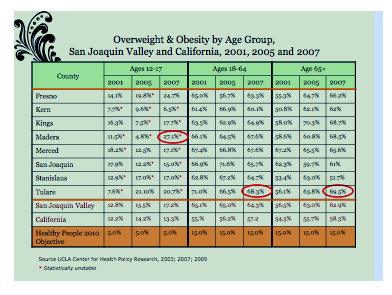
California’s Central Valley is where much of the nation’s produce is grown and where the greatest diversity of farmers live and work, but it is also a region where some of the most concentrated and entrenched poverty exists (Brookings Institute Report).  Some of these rural communities have over 40% unemployment and the current economy is driving the fact that here in the Central Valley, the poorest congressional districts in the nation are suffering greatly from a lack of steady work.  The Central Valley’s primary asset is the agriculture industry that feeds the nation and world; however, the Valley has 40% food insecurity and 67% of adults are obese, while children suffer from chronic disease, hunger and poverty.

California’s enrollment in CALFresh (food stamps) is at the bottom of the 50 states, and the Central Valley has significant barriers to using federal nutrition programs that could improve food workers and farmworkers health.  Health outcomes in the Valley are poor, and much of this can be linked to diet.  The entrenchment of food deserts and food swamps, sporadic emergency food distribution, multiple ‘pilot’ solutions to hunger, and a lack of connections between infrastructure make food access in the Central Valley a social justice issue that needs remedy.

Fresno County is iconic, and typical of all the Central Valley counties.  It is the richest agricultural producing county in the nation and the poorest congressional district in the USA, with poverty and hunger at about 40% according to the California Health Inventory Survey.  This paradox results in an abundance of food leaving the region, broken local produce distribution systems, rural corner stores that only sell cheap junk food and soda, fear of ‘la Migra’ (racism), compromised healthcare, and a lack of potable water and transportation access.  In Fresno, 85% of school children qualify for free lunch, and 33% grow up in extreme poverty.  One-third of children are obese, and 2/3 of adults are obese with a compendium of chronic diseases directly related to diet.  Our food deserts are frequently food swamps, where there is ‘food’ available but it is often unhealthy and cheap.  Fresno City and the surrounding metropolitan area have a population of over 500,000 and the outlying 14 incorporated cities and over 50 unincorporated areas total over 900,000 people.  Significantly, Fresno County produces nearly $5.3 billion from agriculture; however with only one large urban area, most of the county is very rural, as is the entire Central Valley.

Demographics in the Central Valley are changing due to the presence of new immigrants who come from agrarian lives in places such as the Punjab, Russia, Africa, etc. Less than 37% of the population identifies as being white and over 100 languages are spoken in our schools, while we farm in as many languages.  Our residents are poor, undereducated, culturally diverse, and wanting to work hard to support their families.  The economy and woes with water and air quality degradation in our agricultural areas have created a microcosm here in the Valley of the ecological, economic, and social issues that challenge our world.  These statistics are supported by a decade of research from the California Health Inventory Survey (CHIS), the targeted reports of The California Center for Public Health Advocacy by legislative district, California Food Policy Advocates and yearly county nutrition profiles.  Things are not getting better, but we know more about what is happening to people, particularly the disparities of health outcomes that impact people of color (reports from the Central Valley Health Policy Institute on Place Matters).  The Valley’s African American, Hispanic, Punjabi, Hmong farmers, and over 100 immigrant and agrarian peoples, highlight the sustainable ways we are growing food alongside great heritage farms.  However, these farmers and farm workers are most impacted by poor wages throughout the food worker chain.  The foundation for building neighborhoods where fresh food access is the norm for impoverished food workers, will be found in re-localization: re-creating regional food hubs and local purchases of healthy food by existing markets and institutions, and innovative entrepreneurial food work for emerging leaders throughout the eight counties.  In the center of California we produce the ‘goods’: the food, necessary to create a sustainable, healthy and just food system.

What are we doing to solve some of these problems?

Central California Regional Obesity Prevention Program (CCROPP) cares deeply about advocating for and creating the food system that we want here in California based on the organized leadership of those without access to healthy food.  CCROPP is working in the eight Central California counties as a regional initiative on public health through supporting healthy eating and active living for low-income residents.  CCROPP fosters policy and environmental change so that low-income community members have access to healthy food and physical activity opportunities.  CCROPP works on improving access to healthy, affordable, culturally appropriate food for low-income people and for all of us.  The Central Valley raises enough food to feed the nation, yet the very people who harvest our bounty are hungry and over the next decade the Valley is anticipating the greatest population growth in the state.  Due to a lack of infrastructure, the current and future problems of poor health and environmental degradation in the place where most of our food comes from makes addressing Central Valley agriculture critical for the food security of our state and nation.

There is no scarcity of food, rather we have created a food security issue as we have lost local access to local food, and as a result, food workers are the first to be hungry and obese.  If we do not change the policies and systems that create an increasingly obese population inflicted with chronic disease from diet, we all will pay for the costs of increasingly ill neighbors.  Twenty communities in each of the eight Central Valley Counties do not have potable water and this is an agriculture related issue that has gained the attention of the United Nations.  Eventually we will pay for the loss of farmland from unsustainable land use polices and risk losing the knowledge of how to produce our food, as development usurps broken farms.  The conservative Central Valley political landscape defines attitude toward workers, access to wealth and water and land, and short term planning priorities.

The promise of new regional food access by the Regional CCROPP initiative working directly with low-income Spanish language leaders has produced 160 new advocates for change.  The change CCROPP works for includes access to the healthy food they harvest, in their neighborhoods.  Re-inventing regional food systems here in the Central Valley, and taking to scale new enterprise that aggregates and distributes healthy food to rural and low income urban neighborhoods will permanently change health in the Central Valley.  The newly emerging Fresno Food Systems Alliance is a prelude of what is possible at the state and national level.

CCROPP is convinced that as new farmers’ markets, farm stands at schools, and existing corner stores begin to carry local fresh produce, the health of the Central Valley will be impacted for the better.  As the food landscapes in our own organizations, communities, and neighborhoods change through equitable policy, health will improve.  The issues of equity and health of all our neighbors has to be a major focus of re-binding a broken food system.  If the outcome of our current food system is unhealthy people, then we have made huge mistakes, and we must set them straight.  We must restore a healthy food system to restore healthy communities.  Those most impacted by malnutrition in the Valley are those working in the food system and it is these individuals that also have to become involved in repairing the region’s food system.

CCROPP’S citizen job project is creating community support and leading the change in food environments for the nation through fostering environmental and policy change for those most in need.  In an effort to develop strategies towards healthy kids and healthy communities, CCROPP is involved with Leadership Development funded by the Robert Woods Johnson Foundation.  I urgently request that you invest in relationships, resources and common values with neighbors, farmers and all sectors of the food system to create a robust regional food system in the Central Valley to create a ‘State of the Plate’ that ensures our good health!

We can agree, I believe, in these food system values:

Justice and Fairness

Strong Communities

Vibrant Farms

Healthy People

Sustainable Ecosystems

Thriving Local Economies

The Central California Regional Obesity Prevention Program (CCROPP) is the Central California Public Health Partnership’s initiative to create environments that support healthy eating and active living in the San Joaquin Valley.  The regional obesity prevention program is administered by the Central California Center for Health and Human Services and is housed under the College of Health and Human Services at California State University, Fresno.  CCROPP is funded by The California Endowment and Robert Wood Johnson Foundation.