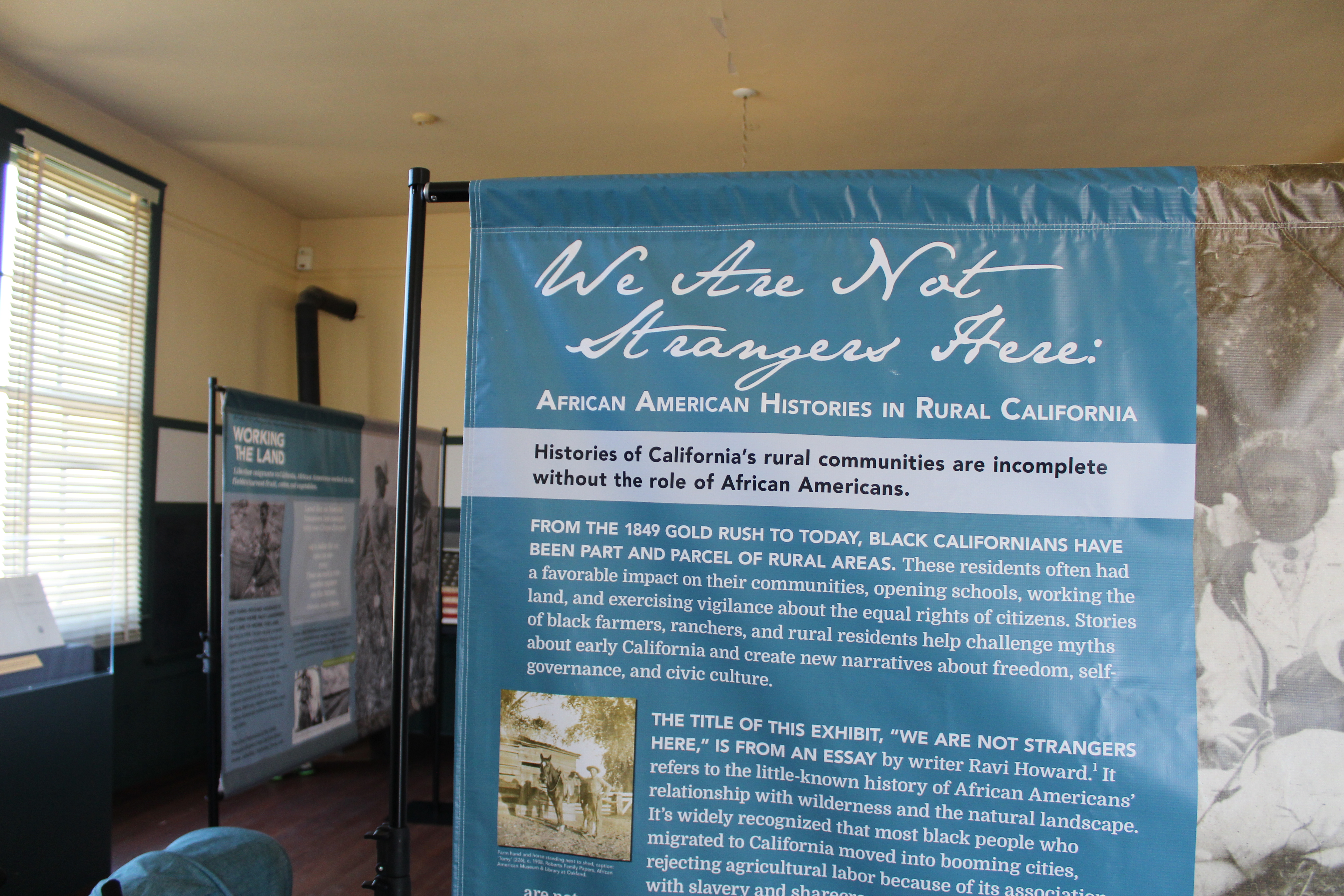
We Are Not Strangers Here highlights hidden histories of African Americans who have shaped California’s food and farming culture from early statehood to the present. The project consists of a six-part Cal Ag Roots podcast series and a physical exhibit designed to travel throughout California. The exhibit features big, beautiful banners full of archival photos that accompany the podcast’s stories. After a COVID-19 pause that delayed the exhibit’s launch nearly a year, the exhibit officially launched in February 2021!
We are also digitally reconceiving the We Are Not Strangers Here exhibit so that people can enjoy it online. Please check out agroots.org for updates on the digital exhibit’s launch.
Exhibit Tour Schedule
February 14, 2021 – May 16, 2021: Sutter County Museum, Yuba City
May 30, 2021 – August 1, 2-21: Colonel Allensworth State Historic Park, Earlimart
August 15, 2021 – October 10, 2021 San Luis Obispo Coast District of California State Parks
October 31, 2021 – December 26, 2021: Tulare County Museum, Visalia
January 9, 2022 – June 5, 2022: The Society of California Pioneers, San Francisco
January 29, 2023 – April 2, 2023: San Diego Public Library, San Diego
We Are Not Strangers Here is shining a light on African Americans in the history of California agriculture and rural communities, and black people’s relationship with food, farming and land. This Cal Ag Roots story series has been in the works for quite some time and we’re thrilled to announce that you can now tune in.
We Are Not Strangers Here will be released weekly– click the links below to listen:
Thousands of African Americans participated in the California Gold Rush. Some were still enslaved when they did like 49er Alvin Coffey. Join us for Episode 1 to learn more about Coffey’s fascinating tale.
One of the most impactful ways we come to know about places is through the stories we tell about them. Discover how Black people in rural California have been remembered–and forgotten–in the stories and landmarks that tell the beginnings of the Golden State.
Black people have long cultivated the land in rural California. And in doing so, they’ve contributed to what we grow and how we grow crops in the state. Discover how early African American farmers and ranchers didn’t just grow crops and raise livestock throughout the Golden State. They also cultivated societal change that helped make California what it is today.
Starting as early as the 19th century, Black communities–large and small, loosely organized and formal took shape across rural California. Discover the undertold history of California’s Black rural settlements including how these communities represent the tension between the promises and the challenges of living in the Golden State.
In 1908, African American pioneers established the town of Allensworth forty miles north of Bakersfield as part of the broader Black Town Movement. Discover how these settlers not only built buildings, established businesses, and planted crops–they also inspired the imagination as they tested what was possible in rural California.
Relationships to the land can be seen throughout African American history and culture. However, Black Californians haven’t just long been connected to the natural world in the past.
Farmhand and horse standing next to shed in Tulare County, Roberts Family Papers, African American Museum and Library of Oakland
The We Are Not Strangers Here stories is being told in two ways: 1) through a traveling exhibition– which will launch in 2021 as cultural institutions re-open in California– comprised of archival visual and textual materials and 2) through our podcast series.We Are Not Strangers Here is a collaboration between Susan Anderson of the California African American Museum, the California Historical Society, Exhibit Envoy and Amy Cohen, Dr. Caroline Collins from UC San Diego, and the Cal Ag Roots Project at the California Institute for Rural Studies. This project was made possible with support from California Humanities, a non-profit partner of the National Endowment for the Humanities (Visit calhum.org to learn more), and the 11th Hour Project at the Schmidt Family Foundation.
Cal Ag Roots Supporters
Huge THANKS to the following generous supporters of Cal Ag Roots. This project was made possible with support from the 11th Hour Project of the Schmidt Family Foundation and California Humanities, a non-profit partner of the National Endowment for the Humanities.
Ahorita lo que estamos viviendo, es que antes pensaban que el oro valía mucho. No. El agua es oro ahorita- ahorita si no tienes agua no puedes producir lo que tienes.
What we’re learning right now is– before we thought that gold was worth a lot. No. Water is gold now. If you don’t have water you can’t produce what you have.
–Tomas, resident of East Porterville and water justice advocate
California, the golden state, is known for many things, chief among them is its status as the breadbasket of the nation and the world. Yet, the ability to sustain agriculture and support the communities is limited by access to water. This podcast examines how access to groundwater is influenced by drought and climate change, but also, how the persistence of drought conditions can be tied to histories of human decision-making and structural racism within the Central Valley.
This story features guest co-producers Dr. Clare Gupta and Cristina Murillo-Barrick; two social scientists on a team of hydrologists, engineers and economists at UC Davis. As part of a larger National Science Foundation research project, Clare and Cristina partnered with the Community Water Center to collect bilingual narratives of impacted residents who don’t have access to safe and affordable drinking water. They spent time talking with people who live and struggle with these issues every day to learn about experiences, strategies and triumphs related to water justice. They also spoke to leading researchers on California water issues.
We would like to extend a special thanks to everyone who contributed. Community narratives feature several Central Valley residents and water justice advocates: Lucy Hernandez, Melynda Metheney, Vergie Nuñez, Cristobal Chavez, Tomas Garcia, Daniel Peñaloza and Susana de Anda. Researchers include Dr. Jonathan Herman, Mark Arax and Camille Pannu. Podcast editors and collaborators include Ryan Jensen and Ildi Carlisle-Cummins. Audio edits by Victoria Boston and podcast and Cal Ag Roots theme music by Nangdo.
Photo Caption and Credit: Maria Elena Orozco from East Orosi examines a glass of her drinking water, picture taken by Community Water Center
Picture your produce aisle: Strawberries. Tomatoes. Lettuce. Celery. Onions. These crops fill shopping carts across the country and a full third of them come from California. There was a time, though, when California fields grew mostly wheat. Huge tracts of the land we now know as the salad bowl of the world were then pumping out massive quantities of grain, not fruits or vegetables. In the early twentieth century California farming underwent a major transformation that created the abundance you can see in your produce-aisle today.
And one particular group of California farmers really laid the foundation for that transformation. We don’t often hear their names and many of their stories have been long-buried.
According to Isao Fujimoto, “The early success of the Japanese farmers led the Japanese to be productive farmers, but instead of being praised, they got attacked. And the attack came in the form of Alien Land Laws.”
In a lot of ways, you could say Japanese immigrants started California’s produce industry. But racist immigration laws and policies tried to push them out of the rural landscape. A few influential farming families dug in, shaping the industry in powerful ways. Many others left farming as a way of preserving their families and moving forward with their lives.
As we’ll hear, the Japanese American story in California farming is about tremendous ingenuity that’s met with a pretty sinister backlash. And it’s about ugliness that’s met with some pretty powerful resistance.
And the story couldn’t be more relevant right now. As Nikiko Masumoto puts it, “If we as a CA we, as a diverse, beautiful CA we, want to heal some of the wounds of the past, we have to look at what happened before and why has there been an exodus out of farming by some communities of color.”
You might never look at your produce section in the same way again.
You can listen to Founding Farmers: Japanese Growers in California by clicking the red play button above, or by subscribing to the Cal Ag Roots on iTunes. If you review our podcast on iTunes, more people will be able to fund us!
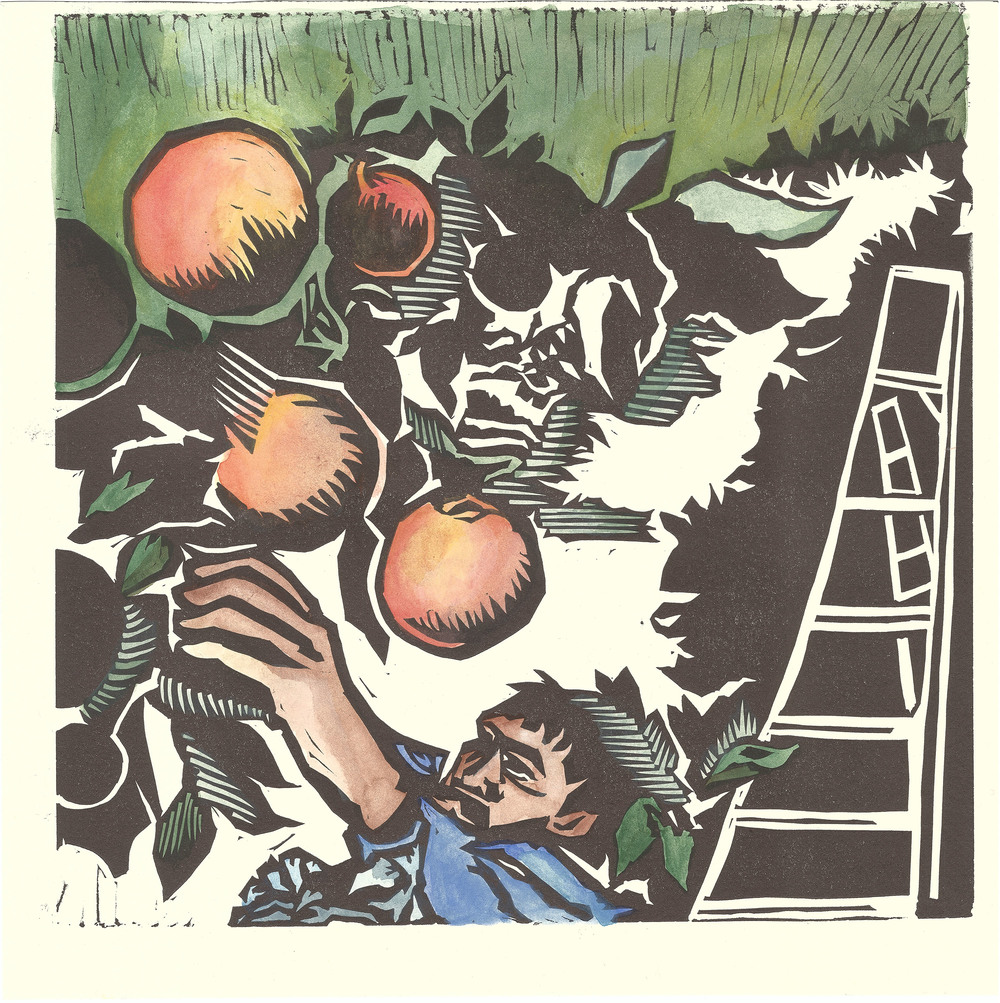
Special thanks to Marissa Ortega-Welch for editing and production help and to Jen Sedell who worked closely with us on this story. Big thanks go out to everyone who’s voices you heard here: Nikiko and Mas Masumoto, AG Kawamura, Tom Izu, Libby Christensen, Jeannie Shinozuka, Isao Fujimoto and Cecilia Tsu. Thanks also to folks who gave me important background information for this story including Naomi Hirahara, Warren Hiyashi, Patricia Wakida, Nina Ichikawa and Valerie Matsumoto. Music for the story was by Komiku and the Cal Ag Roots theme music is by Nangdo– find them both on the Free Music Archive. The beautiful woodcut featured here, Peach Picker/California, was used with permission from Patricia Wakida, of Wasabi Press.
The poverty of the Central Valley of California and the abundance of the region’s agriculture is a conundrum. Even though there has been a decrease in community-based access to healthy food, and a rise in chronic disease in the heartland of the state of California, and the nation, we are beginning to see people and agriculture coming together for the good of both.
The exciting change arising in the Central Valley, honoring our agricultural roots and reinventing our regional economy, has been led by the smart growth investments of Smart Valley Places, with support from the U.S. Department of Housing and Urban Development (HUD), the Environmental Protection Agency (EPA) and the U.S. Department of Transportation. These buds of change are blossoming into a new triple-bottom-line Central Valley economy that honors the environment, equity and economics. Environmentalists, supporters of the organic movement, and advocates for social justice, are not the only ones talking the regional food system talk anymore. The Fresno Business Council, the California Partnership for the San Joaquin Valley and regional cities are choosing smart growth and healthy communities and realizing that the Central Valley, a place with the capacity to feed the nation, can also feed our region. Institutions (such as schools, hospitals and city and county governments) are looking at their ability to access healthier, affordable local food, and the ability for local purchasing to drive their economies home.
This new food regionalism has been a long-term process. Organizations like the Central California Regional Obesity Prevention Program (CCROPP), the eight County Public Health Departments in the Central Valley, and the statewide food movement organized through Roots of Change, have spearheaded bringing healthy people and healthy farms to the forefront of intentional community policy and systemic changes. Fresno will be the host to the next Urban-Rural Roundtable, resulting in a food policy council. This will ensure that the values are in place to focus on regional food. The Fresno Food Systems Alliance has been working across the food system for over a year, and has committed to a Farm to School effort in Fresno County this year.
CCROPP will coordinate with innovative rural school systems to expand the new Central California cooperative of rural school districts that buy local food in Tulare County (Earlimart and Exeter). Farmers markets and produce stands are targeting low-income food deserts, creating the ordinances and zoning options that allow local small farmers to vend today’s fresh produce, in communities where people do not have access to healthy food, and struggle to make a living.
None of this is magic, but times have changed. Demand for healthy fresh food is up, and somehow a tipping point has been reached in an area that before could not see itself as a market for its own goods and produce.
This revised self-image of the Central Valley of California as a valuable region in the state has changed the participation of collaborations grounded in “Valley ways,” and now the region is taking its place in forging a new state future. Because most of the growth increase in California is projected to be where the food is grown, some rethinking of the food system is natural, and potentially the Central Valley can lead the state in assuring that prime farmland does not become parking lots, that our urban places grow up instead of out, and that investment in our rural communities can assure that the environmental degradation of past agricultural practices will be reversed.
In this scenario, the Central Valley becomes the place where the food commons, a regionalization of food and farming, will be piloted with the support of the business world. A new vision for our values and ability to grow healthy food here is emerging, and based in the communities that have historically been left behind by change instigated in urban centers.
In April, at a Fresno City Council meeting, the proposals for the city’s future general plan (that included forward thinking transit corridors, infill preferences, and green building rewards) were presented to the city. Over 87 community residents (of 300 in attendance), with interpretations in Spanish and Hmong, spoke to their preference for smart growth and a plan to revitalize the city center. Then, on April 19, the Fresno City Council voted 5-2 to approve this version for infill, not sprawl, leading the region in smart growth planning, and denying expansion of the city’s sphere of influence.
Cities are passing Healthy Eating Active Living Resolutions. The state is committed to Health in All Policies, and traditional community-based organizations are looking to whole food systems that will create health and access to good food for all, through policy changes and changes in the built environment.
Our grassroots community leaders are asking their schools to implement healthier meals, sourced more locally. They are demanding access to clean, free water for students all day, and requesting safe neighborhoods in which residents can be active.
CCROPP, in eight counties, graduated another 80 new leaders in April (from a year-long leadership curriculum) and the Smart Valley Places’ community leadership institutes are bringing in new members, to 14 separate communities, who care about where their food comes from. These residents also seek ways for their communities to be walkable, bikeable, and have more access to open space and parks. These new leaders from low-income communities of color want community gardens, local produce in their corner stores and the ability to be entrepreneurs in the new food system.
I cannot put my finger on exactly when the economic driver of our region (Agriculture with a Capital A) began to notice that despite a record production of exports, the people here, harvesting that bounty, were hungry. Or, when our elected leadership began to realize that their constituents were consumers, and could be part of an economic stimulus. But for this to occur residents needed access to, and the ability to purchase, local produce. If the Supplemental Nutrition Assistance Program (SNAP, formerly called food stamps, and is called CalFresh in California) were fully utilized by eligible families to buy local food, and if Central Valley institutions could purchase from local farmers rather than purchase local produce that had been shipped away, (then shipped back again and processed) the local economy could benefit. I also do not know when local businesses realized that the Central Valley is predicted to be the highest growth area of the state in the next 20 years, and that there are jobs to be created in value-added foods. But this realization is beginning to emerge.
I would not say that things have to get worse before they get better. I would say though, while we are waiting for future general plans, or an infusion of much needed resources from the federal and state government, we are recognizing what we have, and how we can use what we have, to better the health of our communities. The remaining question is: How can we take existing pilot projects and successful models to scale? Here, where healthy food is grown for the nation, and our residents live in poverty, we want to create a place where access to healthy food is the norm for all our neighbors, especially those who are the experts in growing our food.
The reversal of the current fact of hunger and ill health in the land of plenty is what I am watching for this year.