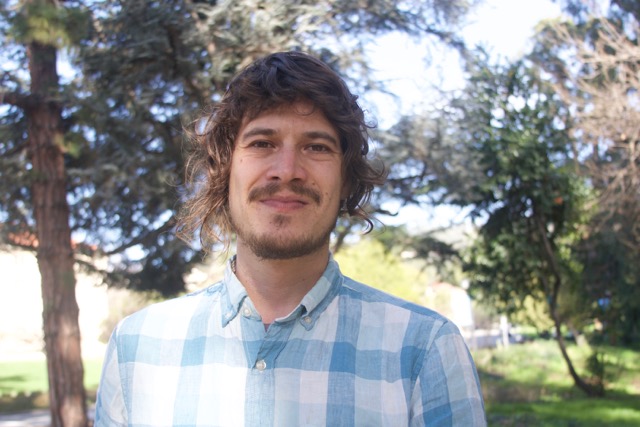
Nina Ichikawa has many identities. She’s the Interim Executive Director at the Berkeley Food Institute, a member of the Farmer Justice Collaborative, a fourth generation Japanese American, as well as a writer about Asian-American food histories. And she’s one of the most insightful thinkers about current issues in California food and farming. Tune in to this Cal Ag Roots episode to find out why Nina wants us all to be telling many more stories about California.
Antonio Roman Alcalá has a lot of ideas to share about power-building in the food movement. He’s an organizer, and a thinker, a theorizer and a farmer. Antonio strikes me as someone who manages to have his hands in the soil AND his eyes on the horizon at the same time. In our conversation at his kitchen table in his tiny Berkeley apartment, I got the impression that he’s often dreaming of possibilities for a collectively-owned, radically diversified farming future, but that he’s also deeply rooted in and actively drawing from history. Which is why, of course, I was excited to talk with him for this podcast.
Antonio Roman-Alcalá
This podcast is part of our series is called Digging Deep: Conversations with Food Movement Leaders about the History of Farming. Tune in to these episodes to learn how food movement leaders’ understanding of the past, and how what they learn from Cal Ag Roots stories, has shifted their thinking about their work.
For centuries, people have been telling other people what to eat. The paleo diet fad might be new, but the idea that some people know what food is best, or healthiest, or cleanest and that other people need to be educated about that is definitely NOT new. It might be one of the oldest ideas we’ve explored on this show.
And it has surprisingly little to do with knowledge about food itself and a whole lot more to do with ideas about whose culture is “good.” Or about “living right.” Or defending a social order. Dig just a little bit into the history of ideas about diet and you’ll quickly find a lot of ideas about race and about class and about power.
But one group of cultural organizers in CA’s Central Valley, at the Pan Valley Institute, has radically shifted this conversation– and by doing that they point the way towards a new model for food movement work that builds political and community strength from difference and diversity.
This story was produced by the California Institute for Rural Studies, Ildi Carlisle-Cummins, director of the Cal Ag Roots Project, and Li Schmidt. Special thanks to everyone who’s voices you heard here: Myrna Martinez, Erica Kohl-Arenas, Melanie DuPuis, Mario Sifuentez, Gail Feenstra, Charlotte Biltekoff and Brenda Ordaz. The music for our podcast was by Dayanna Sevilla and by the Nangdo.
Thanks also to our funders — the 11th Hour Project and the Food and Farming Communications Fund.
This is a Thanksgiving podcast, featuring three tasty audio pieces that celebrate family food traditions and workers who have given their lives to fill our tables. As we lay our tables with feasts this week and gather around them to count our blessings, I wanted to offer you all a bit of a treat. It’s been a long, hard fall for many. So, maybe now more than ever, it seems like people need to take a little care, enjoy a few tasty audio tidbits.
Photo Credit: Lillian Thaoxaochay
Tune in to this 4th episode in our Borderlands of the San Joaquin Valley series to hear two student-produced audio pieces by Cindy Cervantes and Omar Gonzalez and a powerful performance by roots-blues musician and Central Valley native Lance Canales.
Thank you to Cindy Cervantes, Omar Gonzalez– and to Lisa Morehouse and Mario Sifuentez who helped produce their pieces. If you liked what you heard, you can check out other stories like this one, or on iTunes if you subscribe to this podcast. And by the way, if you rate the Cal Ag Roots podcast on iTunes, it will help other people discover it. We couldn’t have produced this story without the generous support of the 11th Hour Project and the Food and Farming Communications Fund.
Dr. Mario Sifuentez is an Associate Professor of History at UC Merced who’s done a lot of thinking about the past and future of California’s Central Valley. He’s been involved with Cal Ag Roots since the very start of this project, both as an advisor and as an interviewee. (You can hear his voice on our third podcast, where he gives us real insight into the Bracero Program.) Mario has deep knowledge about the history of food production, and his current research digs up some interesting new stories about an activist group featured ourCan Land Belong to Those Who Work It? podcast, which is why I wanted talk with him for this Digging Deep episode.
You’ll hear that Mario is also a delight to talk with– he’s real and genuine and doesn’t pull any punches. The Cal Ag Roots story we discuss is, admittedly, kind of obscure, and deals with some complicated federal laws about water subsidies and disputes over who should own farm land . But Mario is really clear on why people should know this story. He told me, “For corporations [farming Central Valley land] is part of their portfolio, right? They are not stewards of the land. And there’s no interest in protecting the land if it’s not profitable. They can let 20 thousand acres fallow, not because they think its good for the soil, but because of the market. When you have people who are stewards of the land, they are looking at it generationally. Thinking about it 100 years from now. Corporations just don’t have that kind of foresight.”
This is the second episode in our new Cal Ag Roots podcast series–Digging Deep: Conversations with Food Movement Leaders about the History of Farming– which will be released every other month. I’m talking with people who are working to shift farming right now, bringing California farming into the future. And we’re talking about how their understanding of the past, and how what they learn from Cal Ag Roots stories, has shifted their thinking about their work. Each of the conversations will draw on Cal Ag Roots stories, so if you haven’t heard them all yet, take a listen here (or subscribe on Apple Podcasts or Stitcher) !
Particularly relevant to today’s podcast is the last one we released—#2, Can Land Belong to Those Who Work it. We’ll keep on producing that style of podcasts and releasing them here—there are so, so many more histories to unearth. The two different kinds of podcasts are going to be in constant conversation with each other, so we’re hoping that you’ll tune into both and that each episode will be more meaningful that way.
Big THANK YOU goes out to Dr. Mario Sifuentez, of course, for the wonderful interview, to Nangdo for the use of all the music in today’s episode, and to Cal Ag Roots Funders including the 11th Hour Project and the Food and Farming Communications Fund.
“I always feel like the day that the Hmong strawberry stand opens in the spring it feels like a holiday to me. It’s as good as Christmas and the best thing about living in Merced.”
Dawn Trook, producer ofthe radio play at the center of Podcast #7, told me there’s absolutely nothing sweeter than the strawberries grown by Hmong farmers in her home town, which is about an hour north of Fresno in California’s Central Valley. It turns out those strawberry stands that Dawn loves so much have a very unique place in the history of California’s Central Valley.
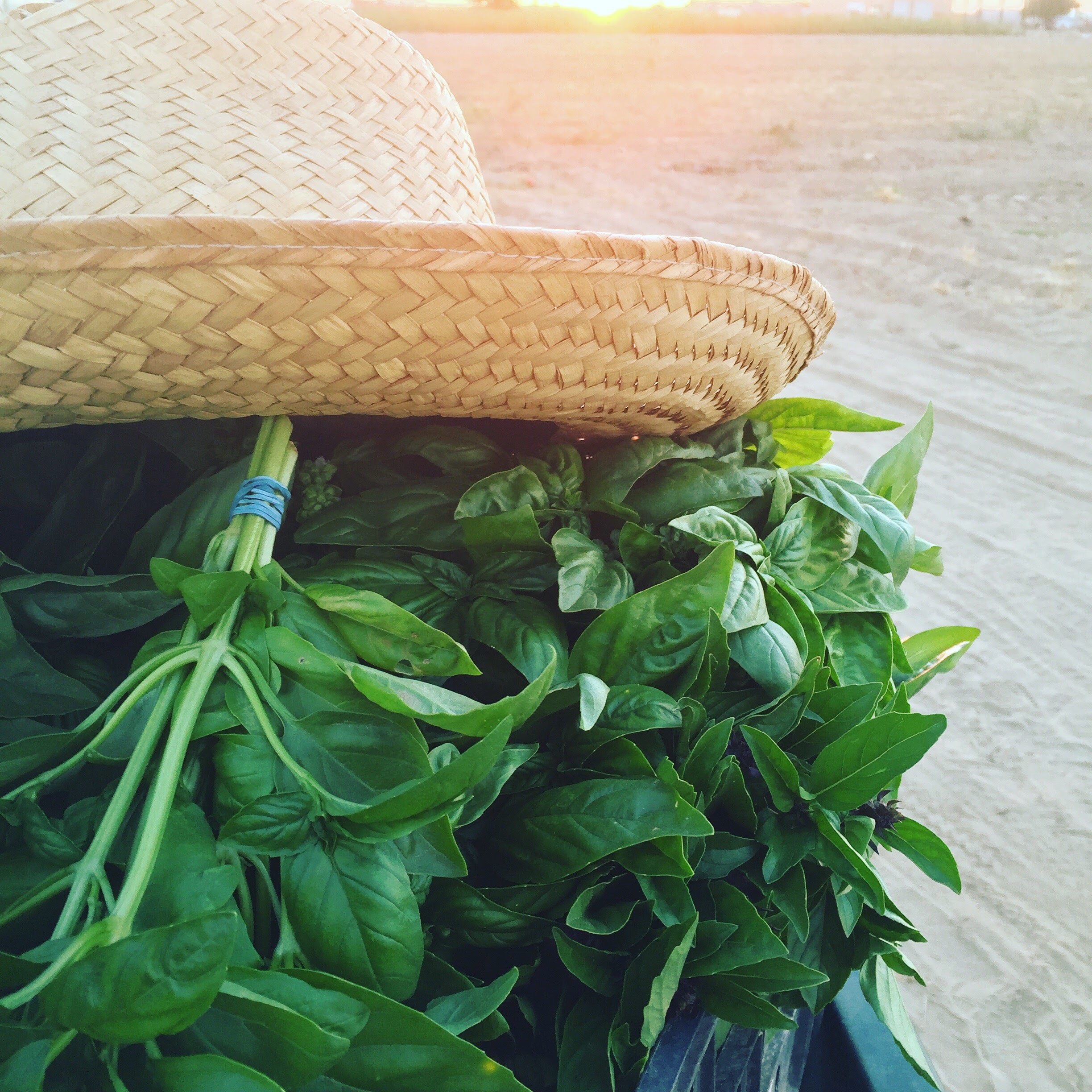
Photos by Lilian Thaoxaochay of her family’s farm in Fresno– GT Florists & Herbs.
For the past 20 or 30 years, Hmong-American farmers have been cultivating scraps of land throughout California’s Central Valley that had previously been considered un-farmable. Like so many waves of immigrants before them, these growers have dotted the Valley’s landscape with surprising patches of green. One family is even rumored to be growing strawberries underneath an overpass in Fresno.
Cal Ag Roots Podcast #7 showcases another performance from our live story-telling event, Borderlands of the San Joaquin Valley. We’re in the middle of a podcast series based on Borderlands (check out Podcast #5, if you haven’t already heard it). You’ll know if you’ve listened to previous episodes that we’re not afraid to feature works of art as a way of exploring farming history. The radio play, Ours to Lose, written by Yia Lee and produced by the Valley Roots Project, is based on an interesting research process. The play was written using a Story Circle process that involved interviews with real farmers from across the Central Valley. The result is a powerful and revealing portrait of Hmong-American farmers that really rings true, as you’ll hear in the audio portrait of Lilian Thaoxaochay, Hmong-American farm-kid-turned-anthropologist, which is the second part of our podcast.
I sat with Lilian in the shade of a mulberry tree on her family’s farm on 106 degree day in July. The heat seemed to have absolutely no effect on her brain activity, because she had incredibly interesting things to say, like,
“Hmong agriculture is not about economy. It’s about survival and sustainability and making yourself.”
Lillian’s comments stitch the fiction of Ours to Lose with the reality of her life. In a way, Lilian and this episode are in direct conversation with Podcast #6, which was an interview I did with farmer Mai Nguyen.
Mai made a powerful comment in that episode, which has really stuck with me. She sometimes frames the urgency of her work in terms of what it takes to combat climate change. She said that she has approximately 40 tries over that many seasons to get things right. And that, she told us, is going to take a polyculture of many minds.
We need borderlands and the people who are really good at navigating them because they are places where there’s a cultural equivalent to the ecological concept of the “edge-effect.” In ecology the richest places are where edges of environments come together, where rivers meet the ocean, where forests meet the meadow, where mountains meet the valleys. And the cultural edges of places like the Central Valley, I think, are exactly where we’ll find the ideas and innovations we need to move us into a farming future that we all want to live in.
It seems like this planet is really ours to lose.
This story was produced by the California Institute for Rural Studies and Ildi Carlisle-Cummins, director of the Cal Ag Roots Project. Cal Ag Roots is unearthing stories about important moments in the history of California farming in order to shed some light on current issues in agriculture.
Special thanks to the voices heard in this episode including Janaki Jagganath, Dawn Trook, the Ours to Lose Actors—Fuchi Thao, Ka Vang and Fong Xiong and Lilian Thaoxaochay. Thanks to Lilian for lending us the use of her beautiful farm photos—featured throughout this article. https://www.facebook.com/gtflorists Music for this episode was by Xylo-Ziko and Komiku and the Cal Ag Roots theme music is by Nangdo.
And a shout out to Cal Ag Roots funders including the Food and Farming Communications Fund and the 11th Hour Project. Thank you!