Mai Nguyen is an innovative grain farmer and an influential farmer organizer. In this interview, the first in our new series of conversations with food movement leaders that we’re calling “Digging Deep,” Mai talks with Ildi Carlisle-Cummins about how examining our agricultural past is the only way to move into a just, healthy farming future.
As she puts it, “I, like other farmers, have perhaps 40 tries to grow my crops. That’s not many, but we have more data points by looking back and looking around us. Scale isn’t about one individual using their monoculture of the mind to manage vast acreage. Scale is time, human history, diversity — the polyculture of many minds working lands in different ways throughout time and at the same time.”
This new Cal Ag Roots podcast series — Digging Deep: Conversations with Food Movement Leaders about the History of Farming — will be released every other month. I’ll be talking with people who are working to shift farming right now, bringing California farming into the future. And we’ll be talking about how their understanding of the past, and how what they learn from Cal Ag Roots stories, has shifted their thinking about their work. Each of the conversations will draw on Cal Ag Roots stories, so if you haven’t heard them all yet, take a listen here (or subscribe on Apple Podcasts or Stitcher)!
Particularly relevant to today’s podcast is the last one we released—#5, Borderlands of the SJV. We’ll keep on producing that style of podcasts and releasing them here—there are so, so many more histories to unearth. The two different kinds of podcasts are going to be in constant conversation with each other, so we’re hoping that you’ll tune into both and that each episode will be more meaningful that way.
Big THANK YOU goes out to Mai Nguyen, of course, for the wonderful interview, to Nangdo for the use of all the music in today’s episode, and to Cal Ag Roots Funders including the 11th Hour Project and the Food and Farming Communications Fund.
Recently, the United States Citizenship and Immigration Services took the phrase “securing America’s promise as a nation of immigrants” out of its mission statement. The agency now focuses on “fairness, lawfulness, efficiency…and safeguarding the homeland.” In this political climate of xenophobia, fear and racist attempts to re-write American history, it is crucial that we tell, tell loudly, and tell often the stories of wave after wave of immigrants who shaped this country through every era of its existence.
California’s agricultural empire, the great Central Valley, is no exception. From the Chinese to the Japanese to the Filipinos to the Portuguese to the Armenians to the Sikhs to the Hmong, dozens of groups of people from all around the planet have dug their shovels and fingers into California dirt, planted seeds and cuttings with their machines and their hands, carved irrigation furrows and ditches with their tools and their sweat and tended craggy, sandy, cropland until it burst with bounty.
Cal Ag Roots Podcast #5: Borderlands of the San Joaquin Valley shares stories about immigrant innovations in California farming that were told live at the Merced Multicultural Arts Center. Tune in at the link above, or on Apple Podcasts or Stitcher to hear them.
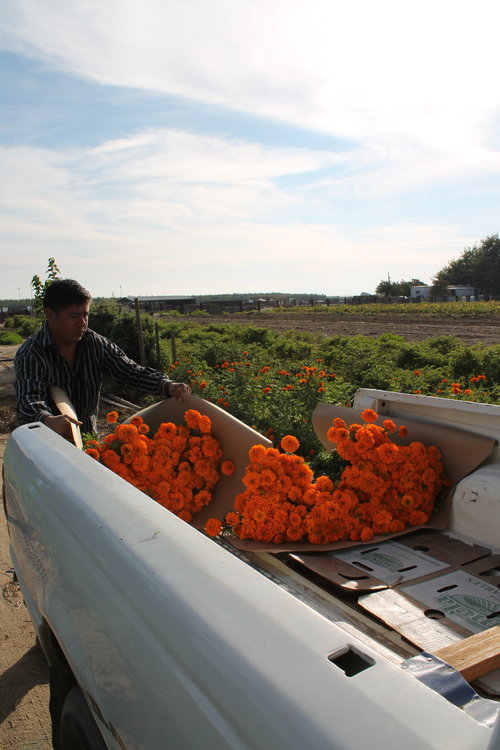
Photos by Janaki Jagannath and featured on the Marigold Society website.
There’s a stubborn, pernicious myth that masks that truth, of course. If we learn about California agriculture at all, we learn about technological miracles, about landscapes transformed through a massive infusion of science and money. If we picture the farms behind our supermarket abundance at all, we picture white, male farmers—a thousand Old McDonalds and their quaint red barns. And if we think about who harvests our food at all, we think about Mexican workers, anonymous, hunched over, faces covered.
But of course the truth is so much richer than those tired storylines. Not only is the Central Valley one of the most diverse places in the United States, but the immigrants arriving there through the centuries brought something with them besides capable hands and strong bodies. Yes, many of them were funneled into the industrial agricultural system and became a key input for California growers as they implemented their crop plans. But many also came to CA from rural areas—the plains of Laos, the mountains of Oaxaca, the Azore islands—with social, cultural and ecological knowledge about how to grow food.
Their farming wisdom shaped the industry in many small and large ways. A Japanese farmer invented the strawberry basket that allowed that fragile fruit to get to market. The iconic bing cherry is named for the Chinese farmer who first bred them. Filipino farm workers were striking and union organizing in farm fields before the formation of the United Farm Workers. Portugese immigrants invented California’s dairy industry and by the 1960’s were producing more than 90% of the milk in the state.
And because those stories are textured, vibrant and reflect reality more than the glossy, technology-worshiping, stories of powerful agricultural magnates, they crack open the myth of California farming. Telling these stories, telling them loudly, and telling them often is the only way to secure America’s promise as a nation of immigrants—and to safeguard the homeland.
Huge thanks to the voices heard in the Borderlands of the San Joaquin Valley podcast: Isao Fujimoto, Janaki Jagannath, Marisol Baca, Aideed Medina and Lupe Martinez (music). The Cal Ag Roots theme music is by Nangdo. We’re grateful to the Merced Multicultural Arts Center for hosting our live Borderlands event and to Tim Emerich and Roberto Mora for helping us to capture audio and video from the event.
Special shout-out to two key Cal Ag Roots funders: the 11th Hour Project and the Food and Farming Communications Fund. We couldn’t do this work without you!
(Photos by Janaki Jagannath and featured on the Marigold Society website.)
On a rainy night on March 21, 2018 in Merced, Cal Ag Roots friends and fans gathered to hear stories celebrating the people who skillfully criss-cross cultural borders dozens of times a day as they shape the landscape of the San Joaquin Valley. Borderlands was a live story-telling event that challenged the common misunderstanding that the Central Valley is an agricultural wonder of the world because of a magical mixture of technology, capital and land. Taken together, the Borderlands performances, told an entirely different story. The stage lights of the Merced Multicultural Arts Center were trained that evening on people from communities who have come to the Valley from around the world with cultural, social and ecological farming knowledge that has helped to build the farming industry.
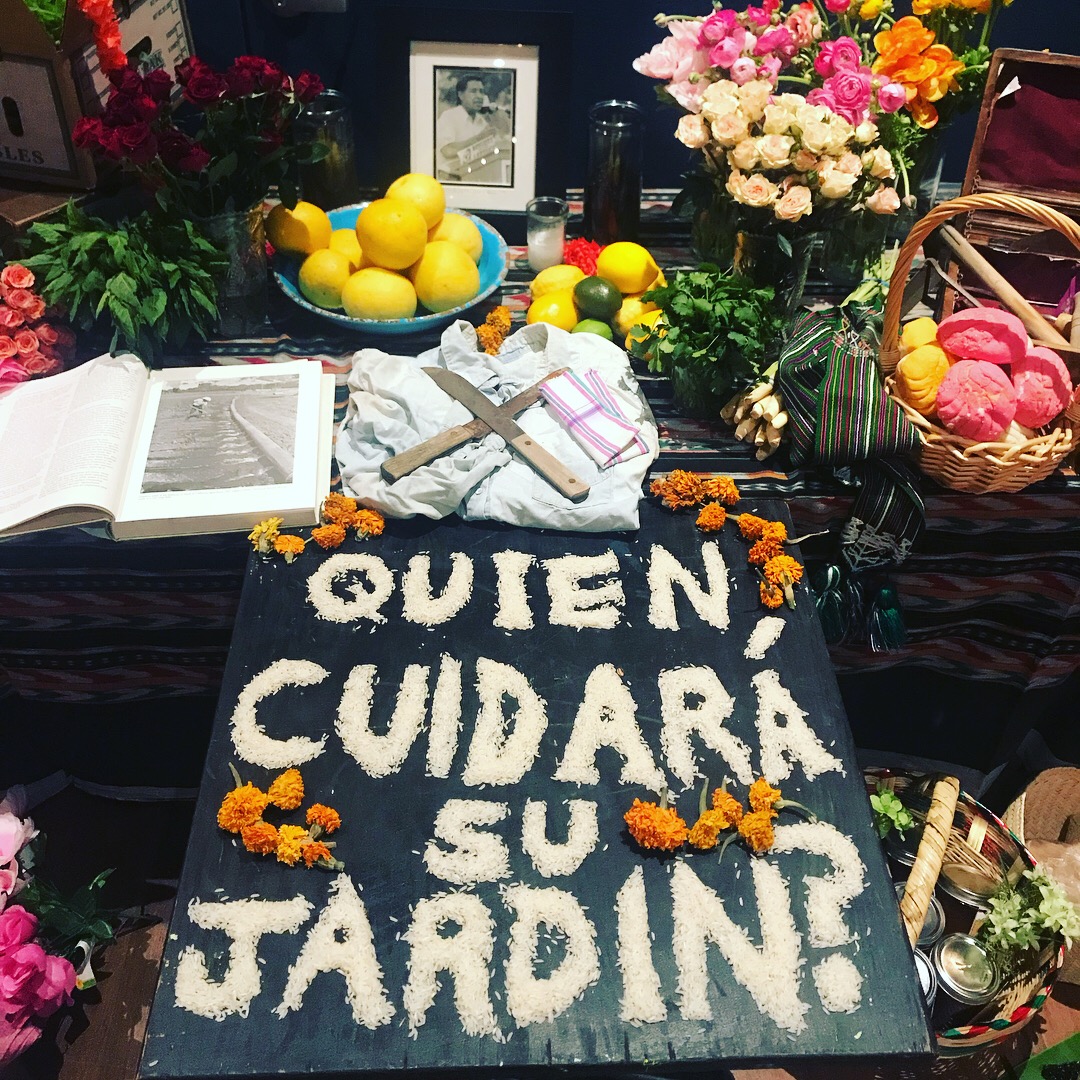
Image by Janaki Jagannath, who created a colorful altar honoring farmworkers at the event.
The black-box theater at the Merced Multicultural arts center was filled with color for Borderlands– Janaki Jagannath built an altar honoring farmworkers that featured a bounty of locally-grown fruits and vegetables along with farm implements, photos and the words “Quien Cuidará Su Jardín?” (Who Will Tend Their Garden?) and gorgeous woodcuts by Patricia Wakida (from Wasabi Press) set the scene for the Borderlands story-tellers’ stirring performances. We heard from Rosa Lopez, an indigenous woman from Oaxaca with a mole-making business in Fresno, and from Brian Nagata, a Buddhist priest who’s studied the history of Buddhist temples in the Valley. We were enchanted by a couple of student-produced audio pieces about family recipes by Omar Gonzalez and Cindy Cervantes and spell-bound by a performance of Ours to Lose, a play about a Hmong farming family written by Yia Lee and performed by Fong Xiong, Ka Vang and Fuchi Thao. A video produced by the Pan Valley Institute, From Our Roots/Desde Nuestras Raices brought the voices and faces of immigrants from across the Valley into the theater. Two powerful, Valley-based poets, Aideed Medina and Marisol Baca, treated us to a collaborative performance crafted just for Borderlands that explored the ways their stories and communities are intertwined. And then there was the music! Lupe Martinez opened the evening with songs and guitar from his field organizing days– and he was joined on vocals by Janaki Jagannath and Martha Armas-Kelly. Dayanna Sevilla sang a beautiful Cumbia del Mole and Lance Canales closed out the show with an incredible performance of Woody Guthrie’s Plane Crash at Los Gatos (Deportee).
This was the second major Cal Ag Roots live story-telling event since the project’s launch. Since March, I’ve been doing a lot of comparing Borderlands of the San Joaquin Valley with our first live event, Docks to Delta, which was performed on the Capitol Corridor train in the fall of 2015. Where Docks to Delta stimulated vibrant conversation and revealed the history behind the landscape we were traveling through, Borderlands moved the audience powerfully with passionate, often emotional, performances in a beautiful black-box theater setting. Designed as a kind of “after-party” for the 2018 Rural Justice Summit at UC Merced, we wanted Borderlands to explore some of the themes we had been discussing all day long at the Summit from a personal perspective, drawing heavily on art and story to open up new thinking about the Valley. I performed a framing Cal Ag Roots audio piece (which you’ll hear in the next Cal Ag Roots podcast episode), but for the majority of the evening we heard from San Joaquin Valley residents, telling their own stories, in their own voices. And the result was an incredibly heartfelt evening that left me feeling fortunate enough to have gotten an intimate glimpse into Valley life.
For those of you who missed the live performance of Borderlands, never fear! We captured the evening on video and audio, in order to share the stories widely. Over the next few months we’ll be featuring some of the highlights from Borderlands live as part of our Cal Ag Roots podcast– and, when we can, we’ll be sharing short videos from the event that relate to each of those stories. Here’s one of our absolute favorite moments from the evening, performed by Marisol Baca and Aideed Medina: Enláces: A Collaboration Between Two Poets.
Stay tuned for more from Borderlands– be sure to subscribe to the Cal Ag Roots podcast on iTunes, Stitcher or wherever you get your podcast fix!
And thank you to Cal Ag Roots funders whose support makes our work possible: The 11th Hour Project, The Food and Farming Communications Fund, The National Endowment for the Humanities, California Humanities, The Switzer Foundation and a generous group of individual donors.
We’ve been hearing a lot of searingly anti-immigrant statements in the news lately. It’s hard to imagine, but Mexican immigrants who came to work in California’s farm fields weren’t always treated as criminals. In fact, Braceros were guestworkers sent to the US by the Mexican government during WWII as part of the war effort. They were young men, sent to save the crops left in the fields as American men enlisted. And they were seen at the time as heroes pitching in– a forgotten part of the “greatest generation.”
Of course, as well-intentioned as the program might have been, things were never easy for immigrant workers here. This is the story of how the Bracero program became abusive over the course of decades, eventually crumbling under organizing pressure from farm workers. And it’s also the surprising story of what that farm worker movement missed in bringing down the Bracero program– told here by people with personal connections to the work.
This story was produced in collaboration with Ignacio Ornelas, History PhD Candidate at UCSC and Archivist at Stanford University, Mario Sifuentez, Assistant Professor of History at UC Merced and Frank Bardacke, independent scholar. Special thanks to Ignacio Ornelas for sharing audio from his extensive oral histories with braceros. Aubrey White served as audio produced for this story.
When you think of California cuisine, do you imagine baby lettuces doused in olive oil, and carefully arranged on white plates?
If you’ve ever driven down the Highway 99 corridor, which cuts through California’s Central Valley, you might have a different sense of the state’s contributions to global food culture. Driving 99 any hour of the day or night, from July through September, you’ll likely have to swerve around trucks mounded impossibly high with tomatoes. You’ll pass acres and acres of dense, low tomato plants being harvested by machines that spit them out into trailers bound for a string of processing facilities that dot the valley.
This year promises to be a record for processing tomatoes, with a projected 14.3 million tons harvested. California’s Central Valley will, yet again, play a critical role in ensuring that one of America’s favorite condiments—ketchup—remains in plentiful supply. On the surface, this cheap condiment might not seem to have anything to do with California cuisine. But, as it turns out, there’s an incredible tale that ties the two together in surprising ways.
When plant breeder Jack Hanna and engineer Coby Lorenzen, two scientists at the University of California at Davis, teamed up in the mid-1950’s to invent a machine that could mechanically harvest tomatoes, no one thought they could do it. The laughingstock of the Davis Plant Science department for more than a decade, the two made countless prototypes that failed—tomatoes split and turned to juice in the field, the machine broke down after hitting clods of dirt.
Plus, when they started, it was cheap and efficient to pay farm laborers, many of whom were brought into the country from Mexico through the Bracero program. These guest workers harvested tomatoes by hand in much the same way that workers in places pick fresh tomatoes today: very gently.
By 1963, rumors started to circulate that the Bracero program was coming to an end and the tomato industry broke into a cold sweat over the prospect of losing 80 percent of the cheap labor force they used for tomato picking. In a dramatic tale of perseverance and ingenuity, Hanna and Lorenzen achieved the break-through they’d been waiting for. The industry quickly pinned their hopes on their rickety machine and the new, tough, easily de-stemmed tomato hybrid affectionately named “vf-145” that scientists were developing alongside it, in hopes that it would withstand a mechanical harvester.
With help from a local machinist named Ernest Blackwelder, and an eager network of financiers and U.C. Cooperative Extension agents, the California processing tomato industry mechanized almost overnight. Within five years, 99.9 percent of the industry was using the mechanical harvesters, and most farmers were planting the comparatively tasteless hybrid tomatoes built to withstand them. And processing facilities retooled their systems to receive the mechanically harvested fruit, reversing the practice of paying premiums for hand-harvested tomatoes.
Twenty years later, nearly all of the tomatoes grown in the U.S. for tomato sauce, paste, ketchup, juice, and other processed foods are harvested by Hanna and Lorenzen’s once-scorned machine.
As Carolyn Thomas, Professor of American Studies at U.C. Davis, points out, the invention of the tomato harvester was not just a technological advance. It was a genuine breakthrough in the way that scientists thought about agricultural development. In order to be successful, the plant scientist had to think first about the physical properties of the tomato as it passed through the machine, rather than thinking about it as a crop destined for markets and mouths. For the thing to work, Hanna had to prioritize compatibility with industrial harvesting and shipping systems over flavor—a breeding practice that we’ve since seen again and again, and which earned the variety the unappetizing nickname of “square tomato.”
Luckily for the industry, Hanna’s new variety landed in foods where it would be seasoned with plenty of sugar and salt. In one telling of this story, this technological breakthrough saved an industry in California that almost certainly would have moved to Mexico as the Braceros returned home.
But the story doesn’t end there. When the University of California released the tomato harvester, they also set loose a machine into California farm fields that ended up having huge social impacts. For one, the new harvesters were expensive and required a lot more land to make a profit. In the first five years after the machine’s release, 4,428 of 5,000 tomato growers went out of business (a whopping 82 percent consolidation in the industry) and an estimated 32,000 farm workers lost their jobs.
At the same time, another band of characters straight out of central casting—a rag-tag bunch of creative and passionate activists—weren’t about to let the U.C. land grant system, a public institution with a mandate to serve all Californians, get away with that.
As the tomato industry transformed and unemployment swept the Valley, a varied coalition of activists solidified into the California Agrarian Action Project, or CAAP, which would later morph into an organization that is still defending small farming today: the Community Alliance with Family Farmers (CAFF).
In 1979, CAAP fired the opening volley in what would be a 10 year legal battle against the University of California, suing on grounds that the tomato harvester in particular—and U.C.’s agricultural research program in general—violated the 1887 Hatch Act, which provided federal dollars for agricultural research intended to support family farming.
From 1979 to 1989, the case moved through the judicial system, with CAAP winning their first suit and eventually losing on appeal. Along the way, however, the activists managed to kick up a whole lot of dust, creating a public debate about who benefitted from technology that came from U.C. labs and whose research priorities consistently fell by the wayside. This P.R. nightmare forced the University to create the Small Farm Center in 1979, which would specifically focus on the needs of low-income and small farmers in California.
Building on this momentum, in 1985, CAAP co-authored a senate bill, which funded the creation of Sustainable Agriculture Research and Education Program (SAREP), an initiative that that would support and legitimize California’s budding sustainable farming industry. CAAP and like-minded organizations with names that are familiar to today’s food movement advocates in California, including the California Institute for Rural Studies and the Ecological Farming Association—were off and running, creating fertile ground for the development of alternative farming systems across the state.
In other words, the mechanized tomato harvester may have paved the way for both the industrialization of our food system and California’s local food revolution (an early spark for the national farm-to-table movement). Advocacy organizations and U.C. programs born out of the tomato harvester fight nurtured the type of farms and farming practices that are highlighted each night on the pristine plates of restaurants like Chez Panisse, Wolfgang Puck, and the French Laundry. And many of the growers who made California cuisine possible were responding to industrial production practices as much as they were drawn farming for it’s own purposes.
So as tomato truckers make more trips than ever to Central Valley processing plants this summer, we can take this story as inspiration to ask essential questions, such as: What kind of California agricultural system would benefit all of us? Who does the system support and who does it exploit? What problems should the Hanna and Lorenzen research teams of today be solving?
While adding ketchup to California cuisine’s white plate might seem like sacrilege to some, digging down to reveal the roots of our food system—and getting real about California cuisine—might help more of us keep these critical questions in focus.
Cal Ag Roots stories focus on pivotal moments in the development of California agriculture. This story and podcast are the first in a three-part series called Docks to Delta, which launched with a live event aboard the Capitol Corridor train in the fall of 2015. Photos published here by permission of the photographer, Richard Steven Street.
Many thanks to Audio Producer Aubrey White and the Agricultural Sustainability Institute at UC Davis, storytellers Bill Hoerger, Izzy Martin, Don Villarejo and Bill Friedland, and the Cal Ag Roots Advisory Council including Lisa Morehouse, who provided crucial editorial advice for this project.
“That land is so rich you could eat it with a spoon!” exclaimed Tom Willey, small-scale organic farmer in California’s Central Valley, referring to the swath of land on the west side of the Valley that makes up the Westlands Water District.
He went on: “I swear to God, they used to say that any idiot could be a good farmer out there because the soil was just so fertile. It was true, absolutely true. And there’s no question that, under a different set of circumstances, 160 acre farms could have been successful out there.”
That figure, 160 acres, is significant. Until 1982, there was a law on the books—the 1902 Reclamation Act— that limited the size of farms allowed to use government subsidized irrigation water across the Western U.S. to just 160 acres. That’s much, much smaller than the kind of massive-scale agricultural development that characterizes California farming in general and the Central Valley in particular.
What may sound to modern readers like a quaint rule was actually meant to be an important safeguard against consolidation of land, power and wealth in the developing West. Most people understand that California agriculture is big, but unless you’ve spent time in the Central Valley it’s hard to imagine how vast the industry really is. Farms stretch for un-interrupted miles, sprawling across tens of thousands of acres. The Westlands Water District spans 600,000 acres (the size of Rhode Island) with fewer than 600 landowners. And farmland values are sky-high in California—the USDA’s 2015 Land Values Summary lists California’s average cropland price at $10,690/acre with strawberry land on the Central Coast rumored to be selling this year for $60,000/acre. This makes it nearly impossible for aspiring farmers, whether they’re young folks or former farm workers, to become farm owners. Had the 160 acre rule been enforced, the situation would be much different; California agriculture, at least in places using subsidized irrigation water, would have been dominated by family-scale farms. So what happened?
In the late 1970s, a group of Fresno-based activists trained a laser focus on this rule and on enforcement of Reclamation Law to promote small farm development, stirring up a surprising—if forgotten—amount of dust.
National Land for People (NLP) was founded in 1964 by a journalist, photographer and energetic, populist visionary from Wisconsin named George Ballis. NLP’s goal was straightforward: they wanted small farmers and farm workers to own the 160 acre parcels that the Reclamation Act promised. They drew their motto—La Tierra Pertenece al que la Trabaja/Land Belongs to Those Who Work It—from Mexican Revolutionary Emiliano Zapata.
Ballis teamed up with a group of people who were committed to bringing attention to the fact that water law was not being enforced in California—and that a small collection of large landowners were getting rich off of government water subsidy. There was Berge Bulbulian, Armenian raisin-grape grower and self-described “farmer front-man” with a sharp wit and socialist politics; Marc Lasher, a social worker from New York who wanted to work for justice in the “belly of the monster”; Mary Louise Frampton, a young civil rights lawyer with a novel (and successful) approach to suing for enforcement of the law; Eddie Nolan, organizer of African American farmers in the Valley, and Jessie De La Cruz, one of the first female organizers for the United Farm Workers who would go on to put together an important farming cooperative in the Valley. And there was Maia Ballis, George’s “collaborator in life,” joyful co-conspirator and talented graphic artist.
Photo (from left to right) Marc Lasher, Berge Bulbulian, Maia Ballis and Mary Louise Frampton, taken in 2015.
Fired up about what they saw as a wave of “water crimes” being committed in the Valley, the small, volunteer NLP team pieced together detailed records of “questionable land deals” in the Westlands Water District.
From a house-turned-organizing-office in Fresno, the group created maps, graphics, and a fiery newsletter sharing their findings with thousands of supporters. George Ballis pulled no punches. In the newsletter, he called corporate farming businesses “the biggies.” He further propagandized NLP’s work with a graphic of an over-sized dollar bill that read “Westlands Water District” on the top and “2 Billion Dollar Boondoggle” on the bottom, with the line “Paid for by U.S. Taxpayers” running up the side.
In spite of their straight-no-chaser rhetoric, NLP made friends in high places, earning the respect of Congressmen like George Miller and officials in the Department of the Interior, who oversaw Reclamation Act projects.
In addition to speaking truth to power in the Valley, the group also made many trips to Washington D.C. NLP members squeezed into a tiny van to drive across the country to testify at Congressional hearings, staying at the YMCA on their no-salary budget. In spite of Berge’s urging that NLP buy George a three-piece suit to wear for these occasions, he insisted on sporting a long beard and “hippie” clothes to the hearing. George didn’t soften his argument when he was before Congress either, exclaiming things like, “this isn’t a hearing, it’s a pep rally!”
However, building key political allies was not enough to force the government to stop the existing illegal actions in the Westlands. Scraping together a little money, the NLP hired Mary Louise Frampton in 1974 to sue the Department of Interior for not enforcing the Reclamation Act. Fresh out of law school and 24 years old, Mary Louise devised a unique strategy for the suit. Against all odds she won a court order halting land deals across the Western states. The NLP won appeal after appeal– all the way to the U.S. Supreme Court in 1979.
The Central Valley buzzed with controversy. NLP members were labeled “communists.” Even as Valley newspapers wrote of “the biggies” preparing for battle, Maia Ballis reported that, “It looked like we had won!” When the Department of the Interior held hearings on the proposed rules and regulations that they would then use to enforce the law, members of the NLP received death threats. Mary Louise remembers an FBI agent standing guard outside her motel room in El Centro as protection while she prepared to testify. Growers went to outrageous lengths to silence the NLP. According to Mary Louise, they flew helicopters over hearings to drown out testimony and pulled in huge farm equipment to kick up clouds of dust over the grand stands.
And then, in 1980, former Governor of California Ronald Reagan strode into the White House, bringing with him a whole new administration—and Department of the Interior. Some activists speculate that promises to overhaul the Reclamation Act helped him get elected.
Whether or not it was a campaign promise, Reagan’s administration worked with Congress to pass the Reclamation Reform Act. Defenders of the new law claimed Reagan’s changes “modernized” the Act, updating it to reflect the costs of farming in the 1980’s. From the NLP point of view, the law was gutted, with the acreage limitation raised to 960 and the residency requirement eliminated.
Berge Bulbulian read this as a classic capitalist maneuver. “You gamble on breaking the law to make as much profit as possible and then when the law is being enforced you use the profits you made to sway political interests to change the law so your crimes are legal.”
In 1982, NLP admitted defeat on the water issue. George wrote in an NLP newsletter, “We lost not just because of biggie bucks. We lost because what we advocated is against the warp of our time.” But, he insisted, their work was not over: “The struggle to create a democratic, responsible and sustainable food system goes on […] Now we turn our full attention to creating new cultural, social, economic realities on a small scale.“
In what could be seen as a tactical shift, or possibly as retreat, George, Maia and Marc uprooted NLP from the Valley, planting it again on 40 acres they called Sun Mountain, east of Fresno at the base of the Sierra Nevada. Here National Land for People morphed into the People Food and Land Foundation and George poured his boundless energy into building a passive solar house, creating perennial gardens and demonstrating what sustainable living could look like—outside of the reach of “the biggies.”
NLP didn’t win their battle. California farming continued to consolidate and corporate land-holdings ballooned. It’s easy to superimpose 2015 cynicism onto this National Land for the People story and wonder if their Reclamation Act enforcement fervor was foolish. What’s striking about Berge, Maia, George, Marc, Mary Louise and all the other NLP crusaders is the tremendous optimism and idealism that they brought to their work. NLP’s heyday was 30 years ago, not 100, and yet they held an entirely different vision for the Valley—one that would have broken down massive landholdings held by white landowners and transferred them to small farmers and farm workers of color. They looked at the stark, mostly unpopulated land of Westlands and imagined a string of thriving communities and a base for democracy in the Valley. Their optimism, it seems, was the ultimate political act.
Today, with water on everyone’s mind, Californians have a rare opportunity to rethink how we want to use this precious, and highly subsidized, resource. Is it to deliver profit into the hands of a few? Or is there another possibility?
Tom Willey wistfully reflected, “I once wished to hell I’da had 160 acres out there, really.” For many activists in the California food movement, it’s hard not to agree.
Photo Caption: Taken in July, 2015 of NLP members (from right to left) Marc Lasher, Berge Bulbulian, Maia Ballis and Mary Louise Frampton.
Cal Ag Roots stories focus on pivotal moments in the development of California agriculture. This story and podcast are the second in a three-part series called Docks to Delta, which launched with a live event aboard the Capitol Corridor train in the fall of 2015.
Many thanks to Audio Producer Aubrey White, storytellers Tom Willey, Mary Louise Frampton, Maia Ballis, Berge Bulbulian, Marc Lasher, John Heywood and to the Cal Ag Roots Advisory Council including Lisa Morehouse, Janaki Jagganath and Mario Sifuentez who provided crucial editorial advice for this project. Thanks also to historian Clifford Welch, who provided critical background information about this story as well as connection to NLP members.